



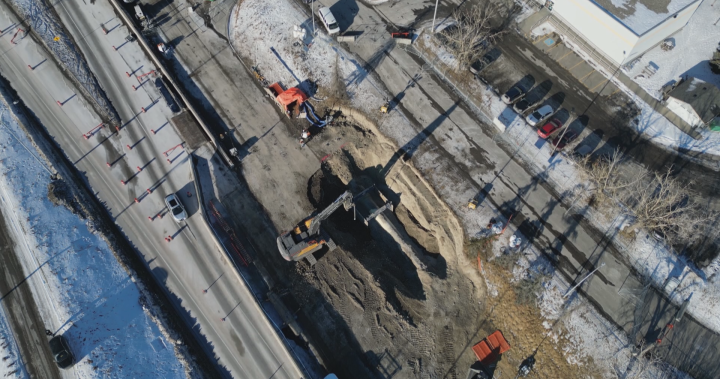
Work to replace the ailing Bearspaw feeder main is set to begin this week, after the City of Calgary cancelled a competitive bid process and instead awarded a sole-source contract.
City of Calgary Infrastructure Services general manager Michael Thompson told city council Tuesday morning that work has been accelerated after the feeder main burst twice in less than two years, with no guarantees the repaired pipe won’t break again.
According to Thompson, materials were ordered on Friday and equipment and crews will be on site in the coming days.
To help expedite the process, Thompson said officials made the “unprecedented” decision to cancel the competitive bid process for the replacement project and instead award a sole-source contract to Ward & Burke Microtunnelling Ltd. and Graham Construction.
That bid process was set to close on Jan. 29, but Thompson said the city didn’t have the time to wait until that deadline as it would impact “having this replacement pipe constructed by next winter.”
“We evaluated the risks that we were facing as a community and made the decision to cancel the existing procurement and to award it directly to a contractor who could start immediately,” Thompson said. “We did that on Friday and that team started on Friday.”
The risks under evaluation include depleting water levels in the Glenmore Reservoir, Thompson said, with just six weeks of city water supply available if it’s relied upon at the same level in the event of another failure or shutdown of the Bearspaw feeder main.
Thompson said the Glenmore Water Treatment Plant was operating at three times its normal winter capacity during repairs of the feeder main, which forced citywide water restrictions and repeated requests to reduce water consumption from city officials.


Get breaking National news
For news impacting Canada and around the world, sign up for breaking news alerts delivered directly to you when they happen.
Calgary Mayor Jeromy Farkas called the effort a “megaproject,” and reiterated his calls to have the replacement line finished in just a single year.
“Our city administration has been given the go-ahead to get shovels in the ground,” Farkas said. “We need to deliver what would otherwise be delivered in four years in one year.”
Construction on the first phase of replacing the Bearspaw feeder main, between the Shaganappi Pump Station and 73 Street N.W. on the west side of the Bow River, was originally scheduled to start this spring. City crews plan to use micro-tunnelling on the first phase of the replacement.
The second phase continues from 73 Street N.W. to 89 Street N.W., with an extension to the Bearspaw Water Treatment Plant.
The original timeline had the project’s completion sometime in 2028.
Kerry Black, a civil engineering professor at the University of Calgary, said there may be unexpected circumstances that arise which could delay the project, but completing the replacement within one year is possible.
“I think it’s a reasonable amount of time,” she told Global News. “Will it require a significant amount of work? Absolutely. Is it going to cost significant resources? Absolutely.”
The total costs of the replacement project have not yet been made public, but Farkas said it could total “hundreds of millions of dollars.”
“I understand that the initial estimate was $200 million, so you’re looking at a bit of a margin above that in terms of delivering the pipe at speed,” Farkas said.
According to city officials, funding for the first phase of the replacement is being covered by $1.1 billion approved by the previous city council council for various city water projects between now and 2031, including new feeder mains and water treatment plant upgrades.
However, Thompson said administration will be requesting more funds from city council for the second phase of the replacement and upcoming reinforcement repairs on the existing Bearspaw feeder main.
City councillors will need to determine where to find the funding required, but Farkas said “all options are on the table.”
“There will be some cost considerations, potentially around property taxes, around rates that Calgarians pay,” he told reporters.
“Make no mistake, there will be significant costs to addressing this issue.”
© 2026 Global News, a division of Corus Entertainment Inc.