


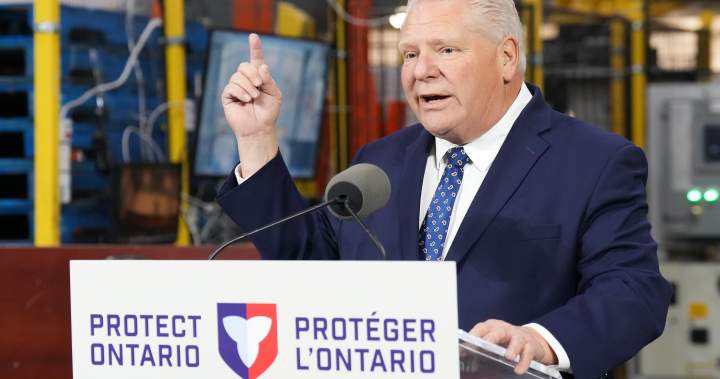
Ontario Premier Doug Ford says he will fight against an order to hand over government-related calls made on his personal cellphone, arguing it would make private citizen information public — something the court ruling explicitly protects against.
The latest twist in a three-year-old transparency battle means the government has twice lost legal arguments that Ford should not have to make parts of his personal phone records public.
The premier said he will keep fighting.
“We’re going to appeal that,” Ford said on Monday. “I’m not going to break their trust, we’re going to make sure they’re confidential, and we’re going to have an appeal,” he added.
At the tail end of 2022, Global News filed a freedom of information request seeking access to government-related calls on Ford’s personal phone, a number he regularly publicizes, while his official device is unused.
The request was denied by the government, before the Information and Privacy Commission overturned that decision on appeal and told civil servants to work out which calls on Ford’s phone related to official business.
The government requested a judicial review of that decision in the Superior Court. Less than three weeks after hearing the arguments for a judicial review, a panel of three judges rebutted the request.
The premier, however, said he wouldn’t budge, arguing the calls he receives contain extremely personal details of his constituents.
“Do you want your personal records about your health care and your family and everything else going public? There has to be confidentiality,” Ford said.


Get breaking National news
For news impacting Canada and around the world, sign up for breaking news alerts delivered directly to you when they happen.
“I get very personal, personal calls about family situations. Very deep, too. And they trust me. So, I’m not going to break their trust; I’m going to make sure they’re confidential.”
The concern about constituent privacy was argued by the government — and addressed — in the appeal and court process.
“I confirm this finding does not deny the affected party or other identifiable individuals privacy protection,” the IPC adjudicator wrote in 2024.
“I do not find Cabinet Office has control over the entirety of the call logs and I am not ordering a ‘blanket release’ of the call logs as Cabinet Office and the affected party suggest. Rather, I find Cabinet Office has control over the call log entries that relate to departmental matters.”
The panel of three judges pointed to that part of the decision, agreeing Ford would not have to release calls from private citizens.
“The Decisions adequately weighed the purpose of access to information and how not granting that access would interfere with a citizen’s right to fully participate in democracy,” the ruling explained. “The Adjudicator considered privacy and was careful to protect personal privacy.”
Both the IPC and court acknowledged separating the two could be a complicated, time-consuming task. They said it is one that would not have been necessary if Ford had used his work phone.
“The work required to identify the government business in the call logs would not impair effective government,” the recent court ruling said.
“This is no different than when an institution is required to search voluminous records to find records that are responsive to a request. This work would not have been necessary if the Premier used his government phone.”
Defending his decision to appeal again, Ford admitted that — by his estimation — some 10 per cent of calls on his personal phone involved government work.
“No one influences Doug Ford, I can assure you of that,” he said. “What is right for the people, that’s my decision, that’s what I’m going to focus on. I would say 90-some-odd per cent, I don’t know exactly, are all personal. People have issues.”
Ontario Liberal MPP John Fraser said Ford’s claim rang hollow, arguing transparency laws are in place to ensure the public knows who has the ear of those in power.
“That’s just not true. Certainly, there are a lot of people who can influence — not just this premier, but premiers who came before him,” he said.
“I think it’s important that when (the) premier is making a big decision and people are lobbying him, they’re calling him, they’re saying, ‘We don’t want you to do this’ or ‘We want you to do that,’ then we should know who is calling him.”
Marit Stiles, leader of the Ontario NDP, said Ford shouldn’t go ahead with his appeal.
“Ontarians shouldn’t have to take the Conservatives to court to get answers about this, but Ford plans to waste more time and taxpayer dollars with another appeal,” she said in a statement.
“Clearly, Ford is conducting government business on his personal phone. Ontarians deserve the truth, and they will get it.”
© 2026 Global News, a division of Corus Entertainment Inc.