






A newly released report from the Macdonald-Laurier Institute says federal and provincial governments need to move quickly if they want to ensure Canadians continue to have affordable electricity prices.
“In Canada we’ve taken very cheap electricity, abundant electricity for granted,” noted Heather Exner-Pirot, Macdonald-Laurier institute’s director of energy, natural resources, and environment.
“It’s been a huge boost for our economy, to our quality of life, and I think many people would be surprised to know that we are kind of eroding that advantage.”
Exner-Pirot explains that production of electricity peaked around 2017, and although Canada’s population increased, demand was kept in check due to a number of shifts.
“We had about two decades where growth was almost flat. We had more efficient appliances, and a lot of energy-intensive industries moved to China,” Exner-Pirot explained.
“It’s only been recently, I would say in the last two or three years that data centres are driving real growth.”
That doesn’t mean there hasn’t been any investment. Alberta is home to more than 6,000MW of renewable energy, which has mostly taken the place of coal-fired plants that have been brought offline or been repurposed to fire natural gas.


Get daily National news
Get daily Canada news delivered to your inbox so you’ll never miss the day’s top stories.
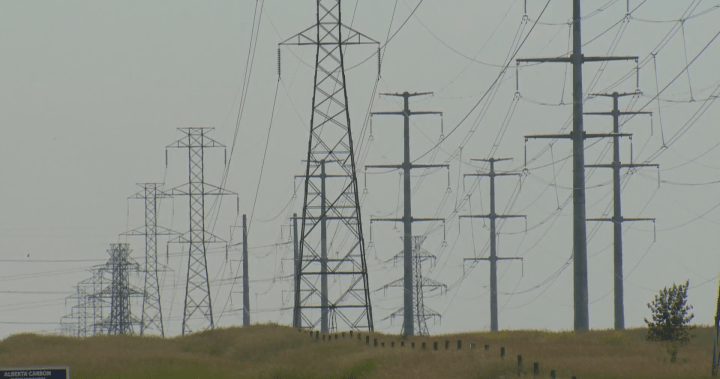
“It’s almost saturated the system; it’s often curtailed and we don’t have enough transmission to get it where we need it to go,” said Exner-Pirot.
“We have a lot of natural gas, that’s the easiest thing for us. We don’t have hydro, and nuclear still feels like it’s a decade or so away.”
In an effort to modernize the grid, the Alberta government introduced legislation in 2025 to transform how it manages its utility system. The intent behind the bill was to improve reliability, affordability and encourage investment, but with new rules not coming into place until 2027, those currently operating are left to wait.
“It’s creating so much uncertainty,” Exner-Pirot pointed out. “Not everyone is going to be happy, and in the meantime we’ll probably wait until we have some finality on what that’s going to look like. How you can generate a business model, based on what assumptions, and in the meantime it feels like we’re spinning our wheels.”
Alberta’s minister for affordability and utilities Nathan Neudorf is confident that these changes will do away with those doubts.
“We’re seeking a re-balancing of the generation mix, and where they’re located,” replied Neudorf. “So all that investment has a path towards a reasonable rate of return. And they do that by optimizing where to build and optimizing what we build.”
And when it comes to the potential for surging prices because of power-hungry AI centres? Neudorf says that was handled through passing Bill 8.
“We literally won’t allow them to draw more power out of the grid than it is capable of giving,” Neudorf said. “Because they have to bring their own power, so we’ve thought ahead, we’ve looked at other jurisdictions and best practices.”
Looking ahead also includes exploring the idea of nuclear power in Alberta. Over the past few months, a nuclear advisory panel has conducted a number of townhalls for two reasons, the first to provide Albertans with information about nuclear power, and also hear their concerns.
Surveys about nuclear power are currently open on the Alberta government’s website, and the panel will deliver its final report to minister Neudorf on March 31, 2026.
© 2026 Global News, a division of Corus Entertainment Inc.


