







Killer whales are the ocean’s top predator — but new research suggests they may not always hunt alone.
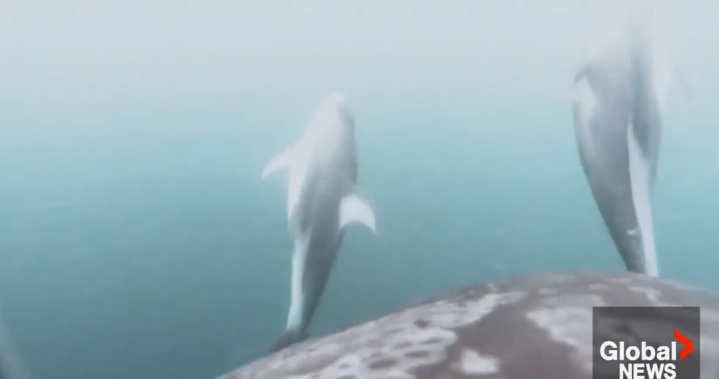
Researchers at the University of British Columbia have captured rare underwater and aerial footage showing northern resident killer whales foraging alongside Pacific white-sided dolphins, revealing an unexpected cooperative relationship between the two species.
The video was collected off the north coast of Vancouver Island near Johnstone Strait, using drones and suction-cup biologging tags temporarily attached to whales.
The team set out to better understand how northern resident killer whales catch their prey, but instead documented behaviour they were not actively searching for.


Get daily National news
Get the day’s top news, political, economic, and current affairs headlines, delivered to your inbox once a day.
“The truth of it is, we never intended to look at this interaction at all,” said Andrew Trites, director of UBC’s Marine Mammal Research Unit, in an interview with Global News.
Researchers first noticed the unmistakable vocalizations of both killer whales and Pacific white-sided dolphins on the recordings. When they matched the sounds with the video, they observed the two predators moving together while foraging.
“What we are seeing is the dolphins are taking the lead,” Trites said. “The whales were turning towards them, and then following them down to depth.”
The footage suggests the dolphins use echolocation to locate fish, while the killer whales fall silent, apparently eavesdropping. Once prey is found, the whales move in to capture it.
“As a result, they find the fish. The killer whale goes in and at one point we hear this ‘crunch’ sound, which tells us that the killer whale has made a successful kill,” Trites said.
The cooperation appears to benefit both species. As killer whales surface to process and eat their catch, fragments of fish escape into the water, where dolphins are seen feeding.
“When the whales are processing their fish, so when they are eating it at the surface, you see all of the bits of fish that escape the whale’s mouth,” said Sarah Fortune, chair of the Canadian Wildlife Federation. “And the dolphins are there likely grabbing those fragments.”
Researchers say the behaviour may help explain why northern resident killer whales tend to fare better than their southern resident counterparts.
“The resident killer whales might have a bit more of an adaptable behaviour, and the ability to coordinate their feeding strategies with other cetaceans,” Fortune said.
The findings, published in the journal Scientific Reports, document 258 unique events of dolphins travelling near the heads of tagged killer whales.
“To be the first people in the world to see this — it was just an unforgettable moment,” Trites said.
© 2025 Global News, a division of Corus Entertainment Inc.


