The federal government is promising to address the issue of copyright protection for Canadian content creators whose works may be used by artificial intelligence models, after Canada’s new AI strategy made no mention of it.
The word “copyright” doesn’t appear once in the 50-page strategy. While intellectual property is mentioned, it’s in the context of AI researchers and innovators that the strategy seeks to champion — not artists or publishers.
Last summer, Artificial Intelligence Minister Evan Solomon’s office said it planned to address the issue of copyright in the strategy, including by emphasizing the role of creators in developing cultural sovereignty protections.
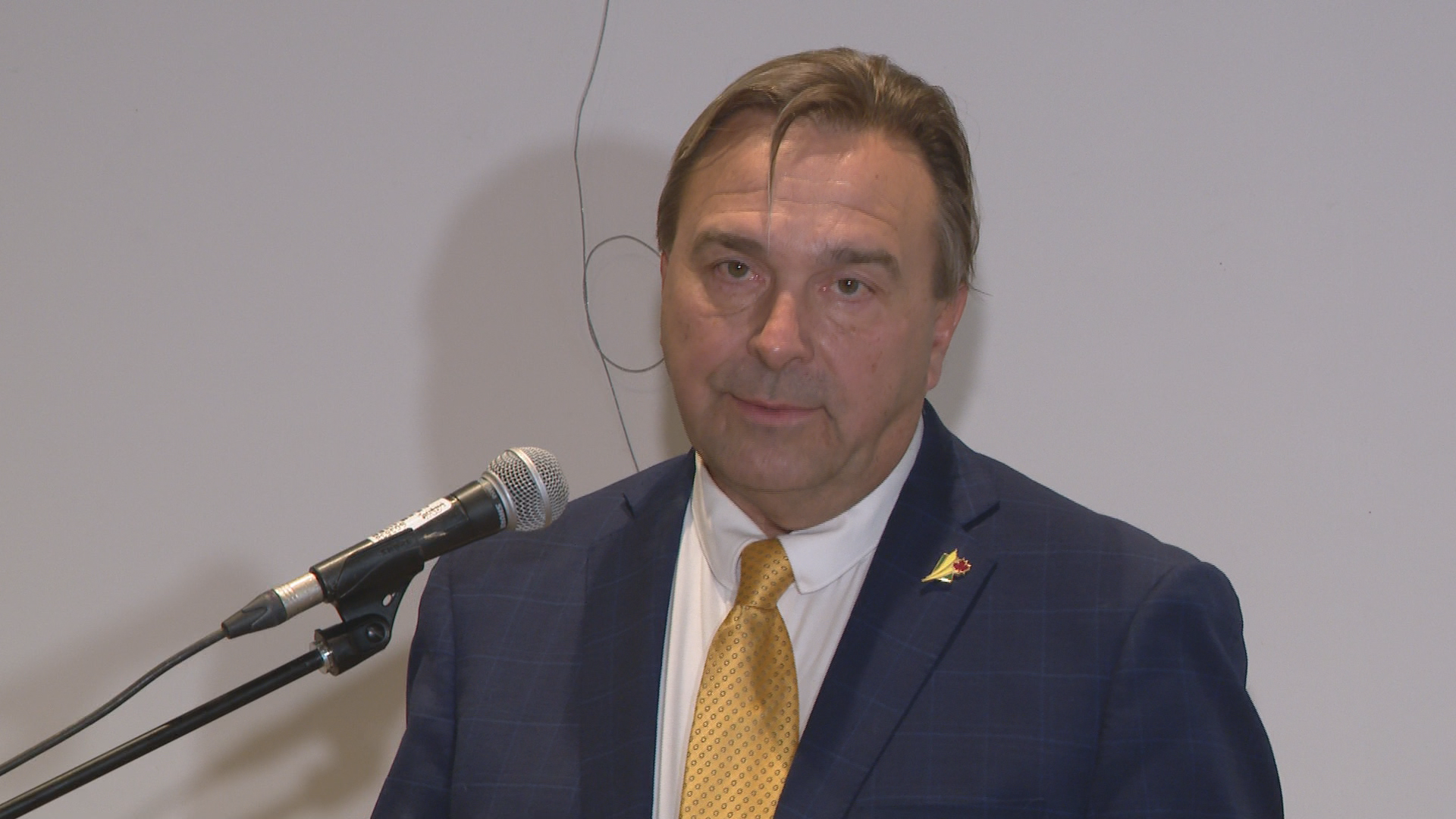
In an interview, Solomon’s parliamentary secretary Taleeb Noormohamed said that work is still underway, and that Canadians should “stay tuned.”
“There’s a lot of comprehensive work that’s being done,” he said, including “ongoing conversations” between Solomon and Culture Minister Marc Miller as well as consultations with the artistic and creative sectors who have made the importance of copyright protection “very, very clear to us.”
“It’s something that we are all very much attuned to,” Noormohamed said.
“We’ve heard them loud and clear, and we know that that’s something that has to be addressed. They are not going to be forgotten through this process, certainly not.”
Asked why copyright is never mentioned in the AI strategy, Noormohamed said the strategy is meant to be a “living document” that wasn’t meant to be “a catch-all for everything” to do with AI.
“Nobody is going to undervalue or understate how important this is,” he said, speaking of copyright protections. “We get it.”
Hadrian Mertins-Kirkwood, a senior researcher at political economist at the Canadian Centre for Policy Alternatives, told Global News he was surprised that an issue as large as copyright protection got no mention in the long-awaited strategy.
“This idea of copyright and taking work without the consent of creators has been kind of dogging the AI industry, and especially the generative AI industry, for the last three years,” he said.
“So it was surprising that it wasn’t addressed or even acknowledged in this strategy.”

Get daily National news
Get daily Canada news delivered to your inbox so you’ll never miss the day’s top stories.
An April survey by News Media Canada suggested 71 per cent of Canadians don’t want to see news content used and repurposed by AI without consent and compensation.
“The fact that the word copyright doesn’t appear once in the 50-page strategy is a miss when it comes to protecting Canadian culture, voices, and stories,” the industry advocate’s CEO Paul Deegan said in a statement.
“The strategy does not offer protections for journalistic content, nor does it mitigate the societal risks of the brazen theft of IP by the AI companies, which is happening on an industrial scale.”
The rapid rise of generative AI platforms like ChatGPT and Claude, which had combed publicly available online content and published works to train their earliest models, has led to blowback on AI companies from privacy regulators and the cultural and media sectors.
A coalition of Canadian news outlets including The Canadian Press, Torstar, The Globe and Mail, Postmedia and CBC/Radio-Canada, are suing OpenAI in Ontario court over allegations their content was used to train ChatGPT without consent.
A joint investigation by federal and provincial privacy commissioners last month into OpenAI’s use of Canadians’ personal data to train ChatGPT acknowledged the lawsuit, but said it’s “not a privacy issue” and fell outside the scope of the probe.
The issue of protecting published and copyrighted content would therefore need to fall to copyright law, rather than new privacy legislation that Noormohamed said will be among the first actions taken “very soon” as part of the AI strategy.
Mertins-Kirkwood said artists and creators aren’t asking for their work to “be left out of the (AI) models, it’s that we need consent and we need compensation and we need credit for it.”
“So I do think it’s a pretty fundamentally different issue” than personal privacy, he said.
The federal government has been looking to update the Copyright Act for years to better protect content creators in the digital age, with consultations held in 2021.
The sudden arrival of generative AI prompted Ottawa to undergo another round of consultations on copyright protections in late 2023.
A February 2025 report on those consultations found the creative sector wanted to see assurances that “creative works in AI are only used with consent, credit, and compensation.”
Technology industries, meanwhile, told the government they wanted to see clarifications in copyright law to “facilitate” text and data mining for AI tools through a copyright exemption.
The consultations informed additional amendments put forward in 2023 for the proposed Artificial Intelligence and Data Act that, if passed, would have allowed government to make regulations on how copyright-protected content was used. The bill died last year after the previous Parliament was dissolved.
This year, in an April report studying the issue, the House of Commons heritage committee said the government should ensure the Copyright Act applies to AI-generated content and require that AI developers be more transparent about the use of copyrighted works to train their models, to allow for “proper authorization and licensing.”
It also called on the government to “establish a clear opt-in consent requirement for the use of copyrighted works in the training of artificial intelligence systems, ensuring that creators’ works may not be used for text and data mining or model development without their prior authorization.”
In the United Kingdom, the Competition and Markets Authority this month ordered Google to allow news sites to opt out of having their online content scraped to feed AI search overviews and other artificial intelligence services and features for British users. The regulator called the move “a world first.”
Noormohamed acknowledged that addressing the copyright issues around AI is a “complicated” task involving multiple jurisdictions, figuring out a proper compensation model, and the prospect of seeking explicit consent from creators.
“It’s a comprehensive piece of work that has to happen, that is being done by people much smarter than me,” he said.
“It’s better, in my view, to get it right than to rush something out the door that satisfies no one and ends up with the (creative) industry getting hurt.”
Mertins-Kirkwood agreed the task is complex but said it would be prudent for the government to set copyright guardrails for the very Canadian AI companies and products the strategy seeks to create.
“A lot of stuff (in the strategy) is very unclear,” he said.
“It speaks to the uncertainty of the moment that we don’t really know what the government means here, and I think they don’t know either.”
—With files from the Canadian Press