





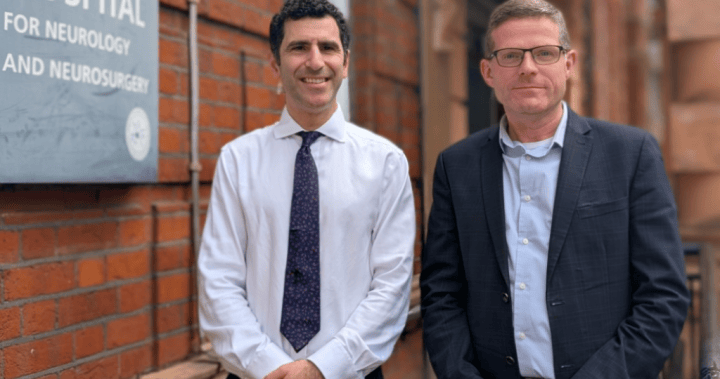
Neurosurgeons in London, England, have successfully completed the first-ever operation to remove a brain tumour using AI assistance, U.K. health officials confirmed.
The operation, which restored the eyesight of a 48-year-old man, took place at the National Hospital for Neurology and Neurosurgery, part of the University College London Hospital’s NHS Foundation Trust, in a clinical trial using AI technology developed at University College London.
Details of the trial were kept under wraps until the patient, Rhys Hibbert, made a full recovery.
Hibbert, a customer services manager and community volunteer from the outskirts of London, is the first patient to undergo surgery in this manner, the foundation explained in a statement.

Get weekly health news
Receive the latest medical news and health information delivered to you every Sunday.
“Without surgery, Rhys’ tumour would have continued to threaten his sight and could ultimately have led to blindness. The operation successfully removed the tumour and protected his vision,” it added.
While the surgical team were in full control of the operation, their AI tool analyzed a live surgical video feed in real time, which helped the surgeons make “more precise decisions by alerting them to critical structures at the base of the brain near his tumour.”
The part of the brain they were operating on, the pituitary gland, is about the size of a marble and is surrounded by tightly packed blood vessels and nerves that control vision, leaving almost no margin for error.
“Going a millimetre wrong can make a critical difference and lead to death, blindness or stroke,” according to the hospital.
The AI tool helped to identify risky areas to avoid while safely removing a much of the tumour as possible.
It also has the potential to track surgical instruments and their interactions with brain matter.
Rhys, who has now recovered from the surgery, said contributing to learning is very important to him and described his experience with the procedure as “humbling,” noting the institution’s illustrious history and reputation as an authority at the forefront of neurological research.
“The National Hospital for Neurology and Neurosurgery was founded in 1859 and was the world’s first dedicated neurosurgical hospital. So to me, it seems very fitting that the same hospital should also be the world’s first to carry out an AI‑assisted neurosurgery,” he told the foundation.
“I’m very pleased to have had the opportunity to be cared for in the hospital… I’m also very humbled to have been asked if I’ll be prepared to be the world’s first patient in this research,” he continued.
Speaking on the first-of-its-kind operation, James Frith, U.K. Health Innovation Minister, said: “This is an example of AI at its best: patients getting care previously deemed unimaginable thanks to the latest groundbreaking technology.”
“I am so pleased for Rhys that he had this life-changing surgery as part of government-funded research that will pave the way for the treatments of tomorrow,” he continued.
“AI needs proper safeguards and we will always ensure that safety is taken seriously. But we will also ensure we benefit from the opportunities it brings to deliver faster and more effective care. That is what we mean by building an NHS that is fit for the future,” Frith concluded.
The surgery was performed by Hani Marcus, consultant neurosurgeon at the NHNN, UCLH, and a professor of neurosurgery at the UCL Queen Square Institute of Neurology, alongside lead surgical resident Danyal Khan.
The UCL Hawkes Institute developed the AI system used in the surgery.
© 2026 Global News, a division of Corus Entertainment Inc.


