




The City of Calgary is beginning the process of establishing a registry of special interest groups and individuals looking to influence decision-making at city hall.
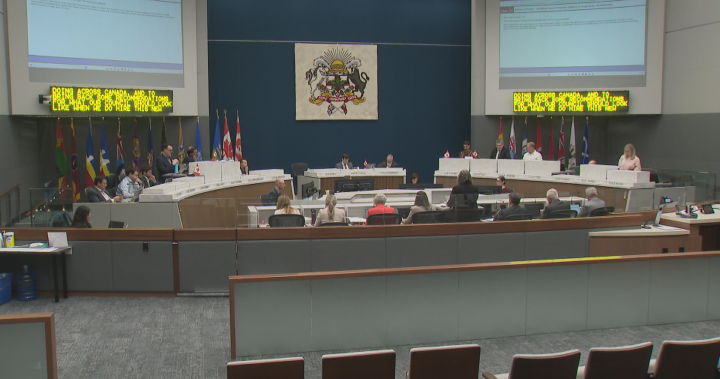
Late Tuesday, city council voted 13-2 in favour of a motion co-signed by Calgary Mayor Jeromy Farkas, Ward 9 Coun. Harrison Clark, Ward 8 Coun. Nathaniel Schmidt, and Ward 7 Coun. Myke Atkinson.
The motion directs city administration to conduct a jurisdictional review of best practices from Canadian municipalities that have established lobbyist registries, as well as assess the scope and coverage of a registry and potential costs.
During debate, Clark said the registry wouldn’t prevent lobbying, but rather ensure “lobbying is conducted openly” to improve transparency with the public.
“It is our responsibility to conduct ourselves in these spaces as openly and as transparently as possible,” he told council. “I don’t think it’s unfair to say that the City of Calgary and this chamber and these offices have seen its fair share of scandals and that the public has every reason to be concerned.”
The moves come after details were revealed of an RCMP investigation into municipal corruption at Calgary city hall related to a reconsideration vote by the previous city council; none of the allegations have been proven in court and no charges have been laid.
Farkas first brought the idea of a municipal lobbyist registry to light once the probe was made public, but he noted he campaigned on establishing one both in 2021 and in 2025.


Get breaking National news
Get breaking Canada news delivered to your inbox as it happens so you won’t miss a trending story.
“Calgary is growing up as a city, right now we manage budgets that rival or exceed that of many provinces,” Farkas told reporters. “When we think of billions of dollars at stake, not just the money but also the potential impact on neighbourhoods and quality of life, it’s really important for Calgarians to have that line of sight in terms of how decisions are made.”
Calgary currently has no mechanism to disclose lobbying activity, the motion said.
City councillors used to be required to disclose who they met with, but that is now voluntary after the provincial government eliminated municipal codes of conduct last year.
“I publish every Friday in my community newsletter exactly who I met with that week and I encourage all members of council to do that,” said Ward 4 Coun. DJ Kelly. “If a lobbyist registry helps increase that transparency then I’m all for it.”
Despite criticism of the motion, including describing it as a “headline grabber,” Ward 2 Coun. Jennifer Wyness voted in support as the move simply studies the idea but doesn’t create a municipal lobbyist registry just yet.
“All we voted on in there was a report back on the possibilities of what a lobbyist registry could be, should be, and what our processes are,” Wyness told reporters.
“You’re going to end up seeing the reality of the situation and it will be hopefully less performative than how this whole topic has been discussed in public.”
That report with options is expected to be delivered to city council later this year for consideration.
John Williams with Alberta Public Affairs said he there are differences between lobbying municipal and provincial governments, including the scale of the provincial bureaucracy, which does have a lobbyist registry.
“It’s complex because you’re dealing with a much bigger bureaucracy and for the average person to stick-handle that, it can scare a lot of people off,” he told Global News.
Williams added he he is concerned a lobbyist registry at the municipal level could make accessing government “more complicated” for individuals.
Concern over access is shared by Ward 10 Coun. Andre Chabot, one of the two votes against the motion.
Chabot said he hears from representatives from community associations and constituents regarding decisions in front of city council, and questioned if failing to be on a registry would impede those types of advocacy efforts.
“The idea of having to be registered under a registry, to me, puts additional burden on regular folks that I don’t think is necessary,” he told reporters.
In response, Farkas noted the registry is to delineate between constituents and lobbyists “who are actually being paid to undertake influencing elected officials.”
“Lobbying is a legitimate activity,” Farkas said. “Residents, business owners, not-for-profit organizations, individuals all have a right to meet with elected officials and to make their case and to have their input heard.”
© 2026 Global News, a division of Corus Entertainment Inc.