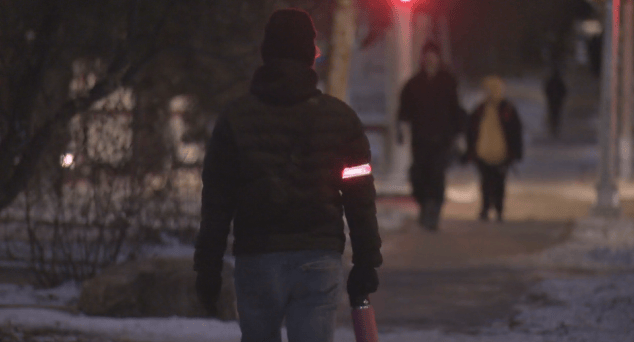




As Alberta settles into permanent daylight time, the later sunrise is becoming a concern for some Edmontonians — particularly when it comes to getting enough morning sunlight and navigating the daily commute.
Joanna MacLean, an associate professor in the University of Alberta’s Department of Pediatrics and medical director of the Stollery Sleep Lab, says patients have come to her for advice on how to get through the darker mornings.
She says sunlight is the strongest signal for setting the body’s internal clock.
“Not having that sunlight exposure in the morning means that our brain thinks it’s still time to be asleep,” MacLean said.
“Less people are talking about the extra light at the other end of the day,” she added.
She says without that morning sunlight, people may feel more sluggish, have a harder time getting going, and struggle to concentrate.
“Reaction time may be a bit slower. More accidents. More interactions between cars and pedestrians,” she said.
Michael Antle, a professor in the Department of Psychology at the University of Calgary, says the body’s natural sleep-wake cycle doesn’t always line up with the schedules people have to follow.
He describes the disconnect as “social jet lag.”
“It’s a mismatch between what our body clock wants to do and what our social clock wants it to do,” Antle said.
Antle explains that people may be waking up while their bodies are still in what is known as biological night, when melatonin — the hormone that helps regulate sleep — remains in their system.


Get breaking National news
Get breaking Canada news delivered to your inbox as it happens so you won’t miss a trending story.
He adds that this can impact one’s well-being.
“When you’re chronically waking up earlier than your body wants, that can lead to increased rates of disease. So, from diabetes to cardiovascular disease to certain types of cancers,” he said.
For some Edmonton families, the darker mornings are also creating challenges during the school commute.
Parker Thiessen says he’s noticed how difficult it can be to see children walking near the road.
“Last week driving here, I drove right past the school because I didn’t know what street I was on,” Parker Thiessen, parent of a Grade 3 student, told Global News as he dropped off his son.
“It’s super hard to see kids walking around. You just can’t see kids. Can’t see people. Everyone’s dressed dark.”
Thiessen says the experience has made him more conscious of the need to pay attention while driving children to school.
Other parents say the adjustment hasn’t been as difficult.
Teddy Kimutai says the darker mornings can make it harder to see, but living close to his child’s school makes the commute easier.
“It’s a little hard. You can’t see the way a little bit,” Kimutai said.
“The good thing is I live pretty close to the school so it’s not too bad for me.”
The Alberta Motor Association (AMA) is encouraging both drivers and pedestrians to take extra precautions during darker morning commutes.
Hannah Hamilton, the AMA’s program manager of Safe Communities, recommends giving yourself more time to get where you’re going and planning routes in advance.
“Try to pick roads that have really good lighting in the morning. Pick routes to school or work that are utilizing intersections with flashing lights,” she mentioned.
“We know based on recent studies that traffic controls like roundabouts, flashing lights, and stop signs create safer intersections by 20 times. So, you really want to pick routes that utilize those features,” she added.
Hamilton also recommends pedestrians travel in groups when possible and use reflective accessories, such as armbands or tags attached to bags, to make themselves more visible.
Beyond the morning commute, Antle and MacLean say there are steps people can take to help their bodies adjust.
Antle recommends maintaining a regular sleep routine, including on weekends, rather than sleeping in to make up for lost sleep.
He says seasonal affective disorder (SAD) lights may also help some people, while those with flexible schedules can benefit from waking up naturally rather than relying on an alarm.
MacLean suggests eating breakfast, particularly for people who don’t normally eat in the morning, as another signal to the body that it’s time to wake up.
For families like Thiessen’s, however, the darker school mornings mean making a few adjustments.
“Pay more attention to those drives to school for sure,” he said.
As Edmontonians continue to adjust to the change, the morning routine remains the same — even if the sun is taking a little longer to join them.
© 2026 Global News, a division of Corus Entertainment Inc.