





Calgary city officials have introduced a plan to implement a series of recommendations from the independent panel tasked with investigating what led to the 2024 failure of the Bearspaw feeder main. However, the total price tag isn’t yet known.
The proposed plan, introduced to the city’s executive committee Tuesday, includes 27 action items across four stages between now and 2027 including stabilizing the water system, establishing new leadership and governance structures, developing planning, regulatory and risk frameworks, and preparing a transition of the governance and oversight of the water utility.
“This is what accountability looks like,” the city’s chief administrative officer, David Duckworth, told committee. “We’re committed to delivering quickly and intentionally on our action plan in your direction to ensure Calgarians and our regional partners know the water system is safe and more reliable than ever.”
The action items are based on recommendations in an independent panel’s review of the circumstances that led up to the critical failure of the Bearspaw feeder main in June 2024.
The report, which was released a week after the feeder main ruptured for a second time, found systemic issues around how the city managed its water utility over the last 20 years, including deferred maintenance and inspections, and a fragmented governance structure that didn’t allow information and concerns to filter up to decision makers within the city.
According to Duckworth, work on eight of the highest-priority recommendations is already underway including fast-tracking construction to replace the ailing feeder main, and advancing other feeder main projects to improve redundancy in the system.
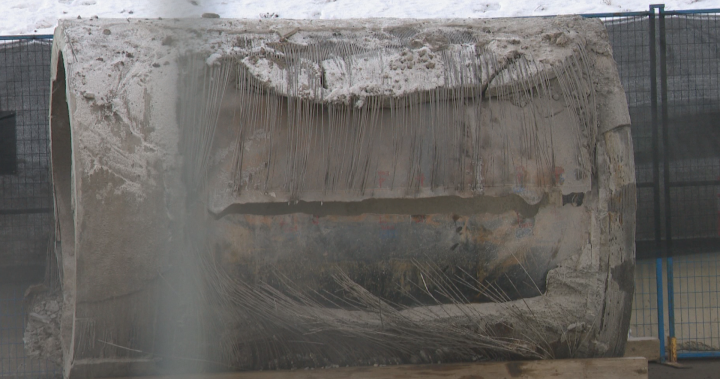
Duckworth said monitoring and inspections have been expanded on the city’s prestressed concrete cylinder pipe water mains — the same type of pipe as the feeder main.

Get breaking National news
For news impacting Canada and around the world, sign up for breaking news alerts delivered directly to you when they happen.
“Prior to returning the Bearspaw South feeder main back into service… three new temporary and one permanent real-time transient sensors were installed to detect potential stress on the system,” he told committee.
In the medium term, city officials said it will recruit a chief operations officer solely dedicated to the water department, as well as establish an independent oversight board for the city’s water utility, which would be recruited by an external third party.
City administration said council would need to approve $3 million to help funding “preparatory activities for governance and organizational design, recruitment, and panel transitionary support.”
Council will also be asked to transfer $50 million from its fiscal stability reserve to its utility sustainment reserve, so that fund is replenished to cover at least 120 days of operating expenses for the water system.
The proposed plan also outlines steps to create a municipally-controlled corporation to govern the city’s water utility, which is targeted for 2027.
That work would include retaining a third party consultant to study options as well as advantages and disadvantages to a new municipal entity.
City chief operating officer Stuart Dalgleish told committee that establishing a municipally controlled entity would require a public hearing, but wouldn’t be required until the end of 2027 if council approves its plan.
Calgary Mayor Jeromy Farkas said the longer term stages of the plan are “a conversation for a later day.”
“It’s a really important first step for council committee to action the recommendations in the report,” Farkas said. “Make no mistake, we’re moving at lightning speed to be able to deliver a reliable and safe drinking water system.”
City council will be asked to approve the implementation plan at its next meeting on Feb. 17, but some councillors are concerned the proposed plan doesn’t include detailed costs.
“We will be potentially making a decision not knowing how much it’s going to cost,” said Ward 5 Coun. Raj Dhaliwal.
City administration said it would be bringing forward a detailed request for funding in March, and will “for the most part” be associated with the short-term actions including the feeder main’s replacement.
However, others on council argued the costs are necessary to begin catching up on issues uncovered within the city’s water system.
“Previous councils have made decisions in order to be able to underinvest in our infrastructure in order to keep taxes low,” said Ward 4 Coun. DJ Kelly. “We see what the consequences of that are.”
Committee voted 13-2 in favour of plan, which will now go to city council for a final say.
Councillors Andre Chabot and Jennifer Wyness were the sole votes against.
© 2026 Global News, a division of Corus Entertainment Inc.


